
AEO vs SEO vs GEO: What Indian Businesses Should Prioritise

AEO vs SEO is a question of emphasis: SEO helps people discover your website, AEO focuses on answering their questions clearly, and GEO considers visibility in AI-generated responses. Indian businesses should establish reliable search foundations, then improve useful answers and evidence before paying for separate AI-visibility campaigns.
1. What do SEO, AEO and GEO actually mean?
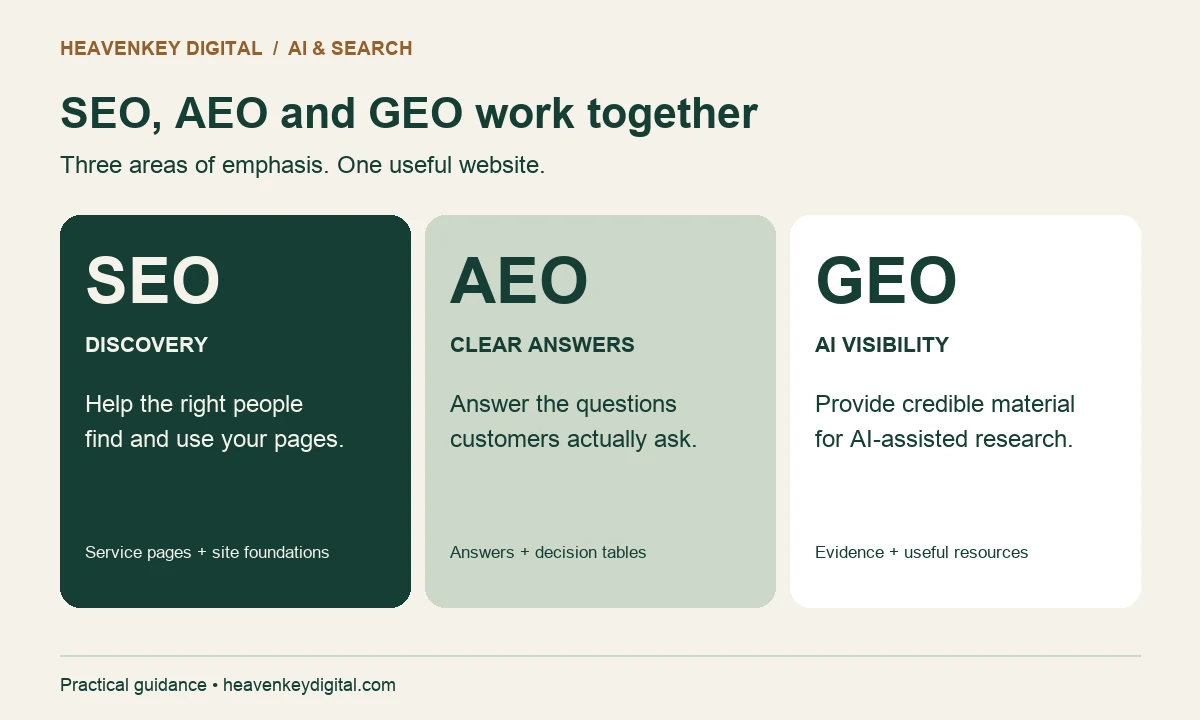
Search engine optimization (SEO) covers work that helps a website be discovered and understood in search. For a local business, the practical objective is to connect a relevant search with a useful page and a sensible next step.
A dentist near Miyapur might need a service page that explains appointment options. A builder might need a project page that clearly separates the location, available configurations and enquiry process. Writing another general article will not fix missing information on either page.
Answer engine optimization (AEO) is commonly used for work focused on making answers easy to find and understand. In this guide, that means identifying a real customer question, answering it directly and providing the detail needed to make a decision.
Generative engine optimization (GEO) describes work aimed at visibility in generated answers. These answers may combine information from multiple sources. The useful business question is whether your material is accurate, distinctive and relevant enough to deserve attention when someone researches the problem you solve.
The boundaries are not universal standards. An agency may call the same page improvement SEO, AEO or GEO. Ask what will actually change, who will verify it and how its value will be measured.
2. AEO vs SEO vs GEO: how does the work differ?
The comparison below is a planning aid. It describes useful areas of emphasis, rather than separate ranking formulas.
| Approach | Owner’s question | Useful deliverable | What to measure |
|---|---|---|---|
| SEO | Can the right customer discover and use this page? | A clear service page, technical fixes and relevant internal links | Search visibility, useful visits and enquiries |
| AEO | Does the page answer what the customer needs to know? | Direct answers, decision tables and practical explanations | Question-led visits and progress towards an enquiry |
| GEO | Does the business provide credible material for AI-assisted research? | Verified facts, distinctive resources and a documented visibility check | Observed mentions, citations, referrals and resulting enquiries |
For example, a pricing page can support all three. Its title helps a reader recognise the topic; its opening explains what affects the price; its comparison table shows inclusions and exclusions. A dated example adds context, provided it is clearly labelled and not presented as a market average.
Do not buy three duplicate articles because the proposal uses three different acronyms. Request one content map showing which page answers each customer need. HeavenKey’s SEO services in Hyderabad provide a starting point for discussing those foundations.
3. What has changed in Google’s AI search guidance in 2026?
As checked on 15 October 2026, Google’s generative AI optimization guide treats work for its AI search experiences as SEO. It does not require special AI markup or an llms.txt file. Eligibility still involves indexed, snippet-eligible pages, and the site must be included through the Search generative AI control.
That guidance concerns Google Search. It should not be presented as a universal rule for every AI product. A proposal covering several platforms should name them and explain which recommendations are documented and which are experiments.
There is also a measurement development worth knowing. Google’s help page states that its Generative AI performance report rolled out worldwide by 31 August 2026. It reports impressions for AI Overviews and AI Mode, with breakdowns including pages, countries and devices. A site may not see the report if it has insufficient impressions.
For an owner, these changes make the brief more concrete: check eligibility, publish something useful and use the reporting available to your property. Do not accept a vendor’s invented “AI authority score” as proof of customer demand.
4. Which approach should an Indian small business prioritise?
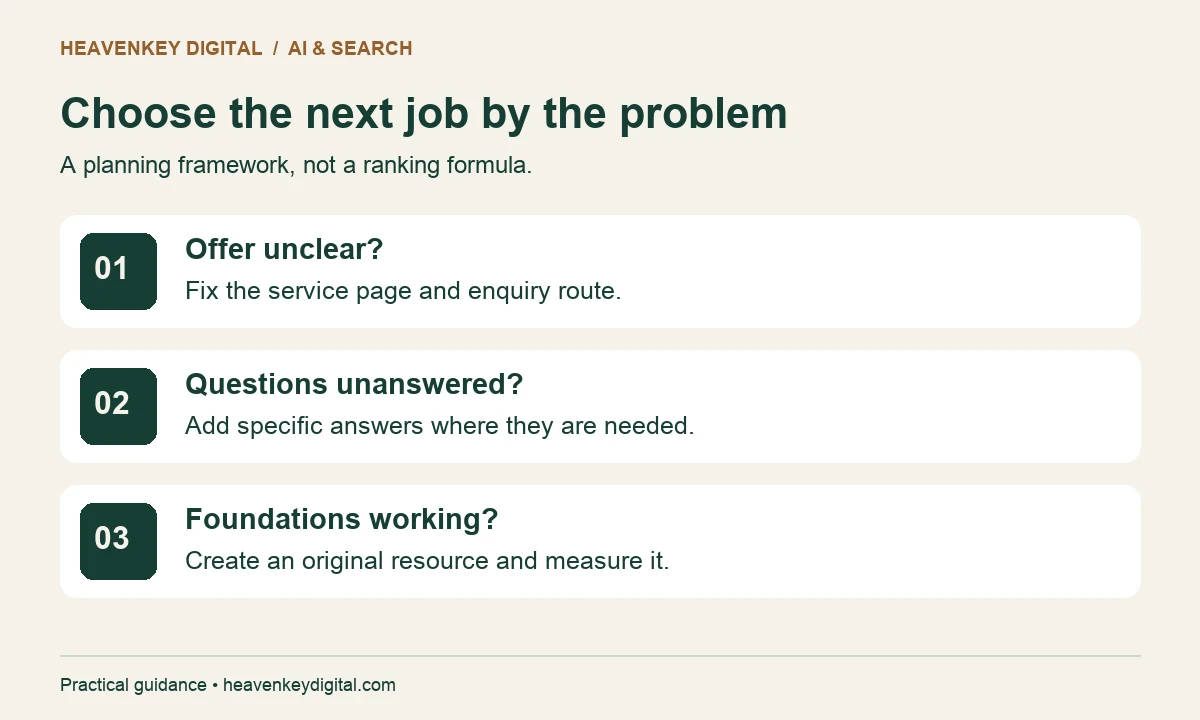
Choose the next job according to the weakest part of your customer journey. The following order is our recommended planning framework, not a claim about a search engine’s ranking weights.
If your website does not explain your offer
Start with your service pages. Write down who the service is for, what it includes, where it is available, what happens after an enquiry and which details require a consultation. Test the form and phone links on a mobile device.
A vague page that says “quality solutions at affordable prices” gives a clinic owner or homebuyer little to evaluate. Replace that wording with details you can support. If you cannot verify a claim, remove it or make its limits clear.
If visitors repeatedly ask the same questions
Add answers to the page where the question arises. Ask the person handling calls to record the wording of common questions without recording private customer information. Group similar questions, then decide whether each needs a short answer, a table or a separate guide.
Keep qualifications beside the answer. “Prices start at…” is incomplete if it omits essential charges. “A site visit is available” needs an explanation of how to request one. Useful AEO work should reduce confusion for an actual reader.
If the basics work and you have distinctive expertise
Develop resources that demonstrate it: an annotated planning worksheet, a documented comparison or a clearly explained process. Then run a small AI-visibility check against questions relevant to that resource.
Give the experiment a limit. For an illustrative ₹30,000 monthly content budget, you might allocate ₹18,000 to priority pages, ₹9,000 to one substantial resource and ₹3,000 to measurement and revisions. This is a planning example, not HeavenKey’s price list or an industry benchmark.
5. What would this look like for a clinic or builder in Hyderabad?
The following scenarios are illustrative. They are not client case studies, and no traffic, patient or sales result is claimed.
A clinic serving Miyapur and Chandanagar
Imagine a clinic whose calls repeatedly concern appointment availability, consultation arrangements and directions. Its first task is a reliable appointment page with accurate contact details and a clear explanation of the booking process.
Its answer-focused improvement could be a section on what a new visitor should bring and how to request an appointment. A qualified clinician should verify any medical content. Administrative guidance should not imply a diagnosis or promise a treatment result.
A useful original resource might be a printable appointment-preparation checklist limited to practical arrangements. The clinic can assess whether enquiries become clearer and whether visitors reach the booking step. That is a more useful test than celebrating an isolated mention in an AI answer.
For an agency brief, connect the work to healthcare digital marketing and specify who approves accuracy before publication.
A builder answering questions from Hyderabad buyers
Imagine a villa project receiving enquiries about location, configuration, possession status and what is included in the quoted price. Prepare one maintained project fact sheet. Every published claim should be checked against the builder’s current, approved documents.
An answer-focused page can distinguish the advertised price from the full cost breakdown and explain how buyers can request current availability. An original comparison worksheet can help a buyer list their own priorities without pretending to offer legal or investment advice.
Measure qualified enquiries and attended site visits separately. Fifty incomplete contact forms and five suitable enquiries are different outcomes. A real estate marketing plan should define that difference before selecting channels.
6. What can you complete in the next 30 days?
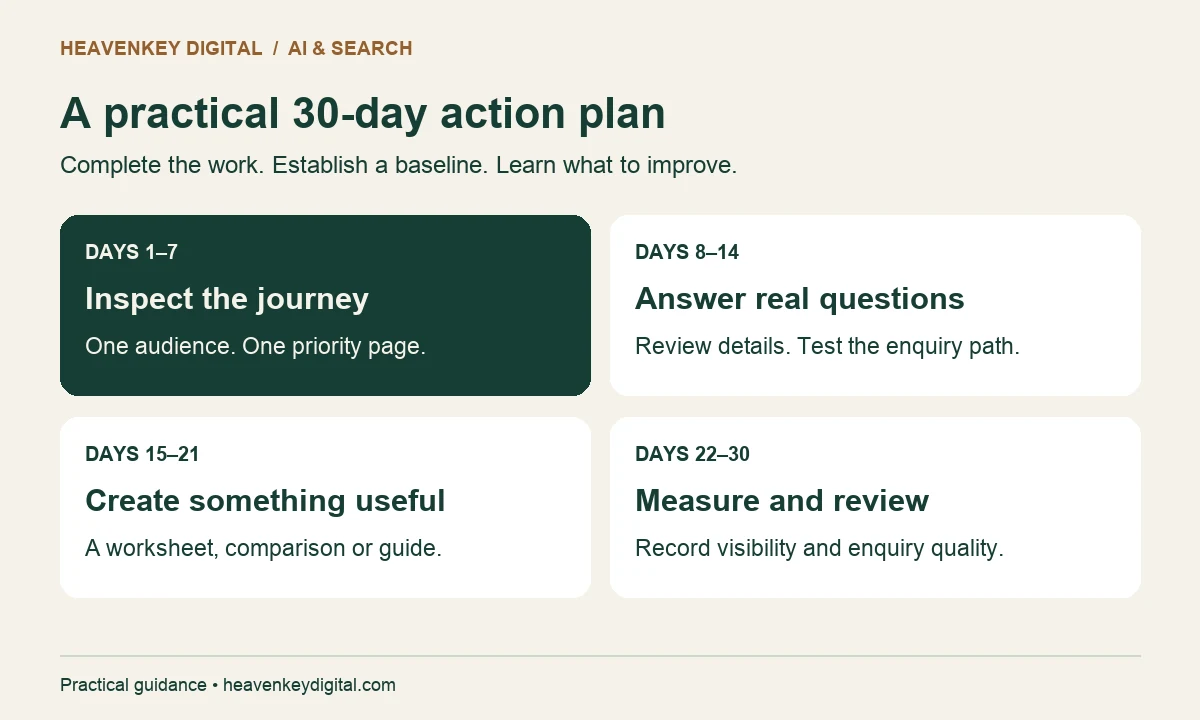
Use this as an implementation schedule. Thirty days is a period for completing and checking work, not a promise of rankings or leads.
| Period | Action | Completion evidence |
|---|---|---|
| Days 1–7 | Choose one customer segment and inspect its main service page, enquiry route and search eligibility. | A short issue list with an owner and priority for each item. |
| Days 8–14 | Improve that page and answer five genuine questions gathered from customer conversations. | A reviewed page with verified details and a tested mobile enquiry path. |
| Days 15–21 | Create one original worksheet, comparison or explanatory guide. | A resource with clear assumptions, sources and a responsible reviewer. |
| Days 22–30 | Record search data, run a small repeatable AI check and review enquiry quality. | A baseline report and a prioritised list of the next improvements. |
Assign one person to maintain the facts. When a service, phone number or project detail changes, update the relevant pages together. Keep a dated change log so you can distinguish a content change from a reporting fluctuation later.
For local targeting, explain a neighbourhood only when it changes the information. A location-specific direction or service constraint can help; cloning the same article for Miyapur, Chandanagar and JNTU adds little for a reader.
7. How should you measure progress and avoid wasted work?
Keep a compact worksheet with four separate rows: search visibility, website engagement, qualified enquiries and observed AI visibility. Record a baseline before changing the page, and note the date of each material change.
For a small AI check, select five real questions and record the platform, date, wording, location context, business mention and any linked source. Repeat the same questions periodically. Save enough context to compare results, but treat the exercise as a sample rather than a market-wide ranking report.
Check whether an answer describes your business correctly. A mention with the wrong service or location needs investigation; it should not be counted as an unqualified success. When a source link appears, inspect whether it leads to the relevant page.
For enquiries, define “qualified” before counting. A clinic might track whether an enquiry concerns an available service. A builder might track budget fit and a requested visit. Use only the information needed for the task and keep personal records out of public examples.
- Avoid generic output: review AI-assisted drafts for unsupported facts and empty repetition.
- Avoid artificial keyword targets: make headings and answers clear without repeating the same phrase mechanically.
- Avoid unsupported guarantees: ask what evidence backs claims about rankings or AI citations.
- Avoid confusing visibility with revenue: an impression, visit, enquiry and sale are separate events.
- Avoid plugin-score chasing: use editorial checks to catch omissions, then judge whether the page helps the reader.
One current schema detail matters: Google’s May 2026 documentation update says FAQ rich results stopped appearing from 7 May 2026. FAQs can still help readers, but FAQ markup should not be sold as a route to that retired display.
8. Frequently asked questions
What is the difference between AEO and SEO?
SEO addresses search discovery and the usefulness of the overall page. AEO places extra emphasis on answering a specific question clearly. They overlap, so an answer-focused improvement can be part of an ordinary SEO project.
Is SEO being replaced by AI?
Google’s current guidance says SEO remains relevant to its generative search features. For a business owner, the practical response is to maintain useful pages and improve the evidence and answers they contain. Abandoning those foundations because of a new label is a poor planning decision.
Is GEO the same as local SEO?
In this article, GEO means generative engine optimization, not geographic targeting. Local SEO concerns discovery for location-related needs. A Hyderabad business may work on both, but they describe different priorities.
Do I need separate SEO, AEO and GEO budgets?
Not automatically. Ask for a list of deliverables and remove duplicated work before assigning a budget. A small, clearly measured experiment can sit alongside the same service-page and content programme.
Can an agency guarantee an AI citation?
Treat such a guarantee cautiously and ask which system, query, date and evidence it refers to. The agency controls its work on your content, but it does not control every response a third-party system produces. Require transparent reporting rather than a promise of permanent visibility.
Ready to choose your next priority? HeavenKey Digital helps Hyderabad businesses connect clear content with practical search work. Explore our AI search optimization services, or request a free strategy call with Mahesh Kumar to discuss your website, audience and next step.